Showing posts with label debt crisis. Show all posts

Saturday, September 1, 2012

Economic Collapse Will Happen No Matter Who Wins Election


Our incumbent President says that things are getting better, jobs are being created, and America is on the road to recovery. His opponent, Governor Mitt Romney, says the opposite, but claims he has a plan that will turn things around and bring prosperity back.

According to free market proponent Peter Schiff, it doesn’t matter who wins, because the crunch is coming – and it’s going to become apparent during the next President’s administration.

He [Mitt Romney] is not going to prevent the crisis. 

We’re headed for a real economic collapse regardless of who wins this election. 

The government has over-promised. There are gigantic Ponzi schemes. They do not work. Meanwhile, the only reason the economy has not collapsed is because interest rates are artificially low. the Fed cannot keep interest rates low indefinitely, and when interest rates go up the party is over. And then we’re not going to have a choice anymore.

We’re going to have to finally deal with these problems or destroy our currency, and that is a real economic crisis that is going to make 2008 look like a walk in the park. 

[The crunch] is going to happen in the next administration.

We can’t fix these problems by repealing Obamacare and cutting taxes. We have structural problems that underline the U.S. economy that are very deep that require real free market reforms, and unfortunately none of the major candidates are even talking about that right now.
Peter Schiff was ahead of the collapse of 2008, warning clients of his firm Euro Pacific Capital that global equities would crash as a result of fraud, unservicable debt levels and a failed monetary policy. After the crash he, like many others, urged Congress to address the fundamental problems within the US economy, including fiscal, monetary and economic policy reform.

He and the American citizenry were ignored as Washington not only didn’t listen, but engaged in exactly the opposite of what should have been done.

Four years on we’re worse off than ever before, with more money having been borrowed from foreign creditors and stolen by the government from taxpayers under the guise of bailing out essential financial and manufacturing sectors of the global economy.

We’re in too deep folks. At this point, it cannot be stopped.

Trillions of dollars are owed, and as a country we have no way to make good on that debt.

Confidence in the US dollar will soon be lost, and when that happens we will experience a collapse in the United States and the global economy unlike any that has ever been witnessed in the history of the world.

Historians will write about this era for centuries to come, just as they write of Rome today.


Thursday, August 30, 2012

Spanish Banks Borrow Record €402 Billion Euro


Spanish banks borrowed a record €402bn ($515bn USD) from the European Central Bank in July, leaving them as far as ever from returning to capital markets, and heaping further pressure on Madrid as it tries to avert a full sovereign bailout.

The banks borrowed 10% more than the €365bn they tapped in June, Tuesday's data from the Bank of Spain showed. Spiralling debt costs and balance sheets ravaged by a domestic property bubble that collapsed in 2008 have shut most domestic banks out of the bond markets.

The banks' use of the ECB facility has increased sharply this year, rising from €161bn in January, and the sector was propped up in July with the promise of a European rescue package – which it has yet to tap – worth up to €100bn.

The pattern is similar if less acute in Italy – like Spain at the sharp end of the eurozone debt crisis – where banks held €283bn in ECB funds in July compared with €281bn in June, Bank of Italy data showed last week.

In Spain, only heavyweights with big operations abroad such as Santander and BBVA continue to have few problems raising funding from the market.

One likely factor in the July increase was the higher charges that some clearing houses were levying on the use of Spanish bonds – which many domestic banks have invested heavily in – as collateral for raising funds, one analyst said.

LCH.Clearnet, one of Europe's largest clearing houses, raised the cost of using Spanish debt as collateral in July following a series of ratings downgrades on the country's debt to the lower end of the investment grade spectrum.

Many investors fear that cleaning up the banking system as well as Spain's public accounts while recession rages may prove too difficult for the government, and expect the country to seek a full-blown bailout on top of the banking aid.

US Economy At Risk For 2013 Recession


The latest data of durable goods orders, released Friday by the Commerce Department showed an increase of 4.2% for July but excluding transportation goods the order declined by 04%. 

In addition orders for capital goods fell 3.4% over the same month while the June figure was revised down to 2.7%. 

The latest data are not only very weak but are a sign of the weakest economic recovery since WWII according to several US economists and analysts. The decline in capital goods orders is a sign that US companies are hesitant to invest and expand their production capacity in light of global uncertainty. 

China, Europe and Brazil, once thought as the economic drivers to set the tone of recovery after the end of the economic recession in the summer of 2009, are now struggling themselves to keep their growth at a steady pace. 

We have seen large dips in economic growth in China to an annual rate of 8%, down from 11% during 2011, and continued fiscal and debt struggles in Europe which largely affect the US economic growth overall since both regions are crucial to the US production output and exports. 

US exports to both regions have been stagnating since 2007 due to a slowing demand from Europe and China. 

China in particular struggles with high inflationary pressures which lead the government to intervene through quantitative easing to ensure their economy does not overheat. That results in a net decline of production materials which in large part are imported from the US. 

Europe on the other hand is still not out of the woodworks when it comes to curbing the budget shortfalls and the debt/GDP ratios of some members which puts extra pressure on Germany, France and The Netherlands to control their inflation for the benefit of euro stabilization. 

The US economy continues to grow albeit at a very slow rate but should the durable goods orders continue to falter then the risk of a double-dip recession in 2013 is not unimaginable. 

This scenario would result in the unemployment rate rising again to 9%, currently at 8.3%, when the expected budget cuts and tax increases take effect early 2013. 

The Federal Reserve has yet to give a sign that it is willing to implement QE3 but given the latest data it is expected that the next FOMC (Federal Open Market Committee) may hint at a higher possibility of bond buy-back programs to curb long-term interest rates even further and to encourage business borrowing and spending to keep the US economy for retracting any further. 

Written by Nick Doms © 2012, all rights reserved.

Thursday, August 23, 2012

Hedge Fund's Record Bet Against Euro


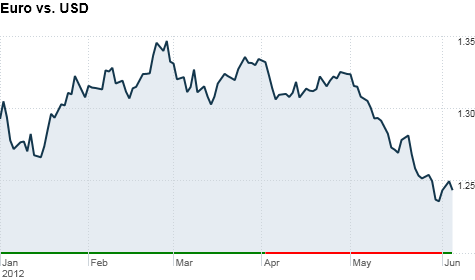
Hedge funds are taking increasingly larger bets against the euro, as the debt crisis in Europe continues to heat up.

A record number of hedge funds made so-called short bets, or wagers that the euro would weaken, according to the latest report from the Commodities 
Future Trading Commission that tallied the data for the week ended May 29.

Citigroup's foreign exchange analysts said hedge funds spent nearly $36 billion betting against the euro during that week. Only $11.8 billion went toward bets on a stronger euro.

The euro is down 7% from April, currently trading around $1.24.

The euro will most likely continue to trend lower, but most experts don't expect a free fall. "It will drip lower [but] there will be no overnight collapse," said Douglas Borthwick, head of trading at currency trading firm Faros Trading.
Hedge funds and other investors are capping their bets on the euro's decline because they could get burned if European leaders intervene, according to analysts and traders.